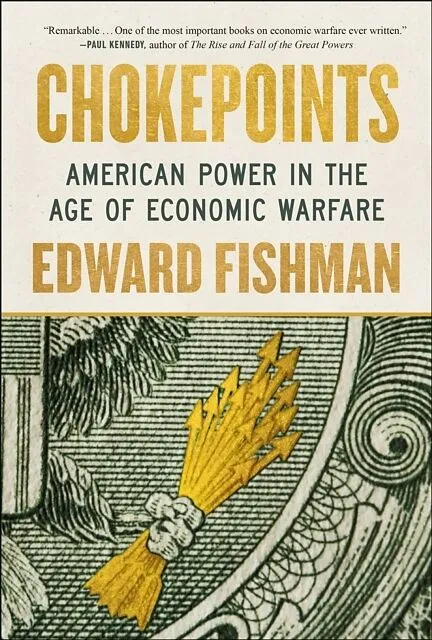
Chokepoints
Beschreibung
The epic story of how America turned the world economy into a weapon, upending decades of globalization to take on a new authoritarian axis—Russia, China, and Iran. It used to be that ravaging another country’s economy required blockading i...Format auswählen
- Fester EinbandCHF 53.20
Wird oft zusammen gekauft
Andere Kunden kauften auch
Beschreibung
The epic story of how America turned the world economy into a weapon, upending decades of globalization to take on a new authoritarian axis—Russia, China, and Iran.
It used to be that ravaging another country’s economy required blockading its ports and laying siege to its cities. Now all it takes is a statement posted online by the U.S. government.
In <Chokepoints<, Edward Fishman, a former top State Department sanctions official, takes us deep into the back rooms of power to reveal the untold history of the last two decades of U.S. foreign policy, in which America renounced the gospel of globalization and waged a new kind of economic war. As Vladimir Putin, Xi Jinping, and Ayatollah Khamenei wreaked havoc on the world stage, mavericks within the U.S. government built a fearsome new arsenal of economic weapons, exploiting America’s dominance in global finance and technology. Successive U.S. presidents have relied on these unconventional weapons to address the most pressing national-security threats, for good and for ill.
<Chokepoints< provides a thrilling account of one of the most critical geopolitical developments of our time, demystifying the complex strategies the U.S. government uses to harness the power of Wall Street, Silicon Valley, and Big Oil against America’s enemies. At the center of the narrative is an eclectic group of policy innovators: the diplomats, lawyers, and financial whizzes who’ve masterminded America’s escalating economic wars against Russia, China, and Iran.
Economic warfare has become the primary way the United States confronts international crises and counters rivals. Sometimes it has achieved spectacular success; other times, bitter failure. The result we live with today is a new world order: an economic arms race among great powers and a fracturing global economy. <Chokepoints< is the definitive account of how America pioneered this new, hard-hitting style of economic war—and how it’s changing the world....
Autorentext
Edward Fishman is a leading authority on economic statecraft and sanctions. He teaches at Columbia University’s School of International and Public Affairs and is a senior research scholar at the Center on Global Energy Policy. He also advises companies on geopolitical strategy and invests in early-stage technology startups. Previously, he served at the U.S. State Department as a member of the Secretary of State’s Policy Planning Staff, at the Pentagon as an advisor to the Chairman of the Joint Chiefs of Staff, and at the U.S. Treasury Department as special assistant to the Under Secretary for Terrorism and Financial Intelligence. His writing and analysis are regularly featured by outlets such as The New York Times, The Wall Street Journal, The Washington Post, Foreign Affairs, Politico, and NPR. He holds a BA in History from Yale, an MPhil in International Relations from Cambridge, and an MBA from Stanford. He lives with his wife and two children in New York City.
Klappentext
**NEW YORK TIMES BESTSELLER • Selected as a Best Book of the Year by The Economist, Financial Times, Bloomberg, and NPR • Finalist for the Financial Times Business Book of the Year Award
"Deftly written, Chokepoints is a compelling and dramatic narrative about the new shape of geopolitics."
— Daniel Yergin, The Wall Street Journal
"A timely, riveting world tour...[An] absorbing book."
— The Economist
“Remarkable...One of the most important books on economic warfare ever written.”
— Paul Kennedy, author of The Rise and Fall of the Great Powers
The epic story of how America turned the world economy into a weapon, upending decades of globalization to confront a new authoritarian axis—Russia, China, and Iran.**
It used to be that ravaging another country’s economy required blockading its ports and laying siege to its cities. Now all it takes is a statement posted online by the U.S. government.
In Chokepoints, Edward Fishman, a former top American sanctions official, takes us deep into the back rooms of power to reveal the untold history of the past two decades of U.S. foreign policy. As Vladimir Putin, Xi Jinping, and Ayatollah Khamenei wreaked havoc on the world stage, mavericks within the U.S. government built a fearsome new arsenal of economic weapons. Successive U.S. presidents have relied on these weapons to address the most pressing national security threats—for good and for ill.
Chokepoints provides a thrilling account of one of the most transformative developments of our time, demystifying how the U.S. government harnesses the power of Wall Street, Silicon Valley, and Big Oil against America’s enemies. At the center of the narrative are the trailblazing diplomats, lawyers, and financial whizzes who have masterminded America’s escalating economic wars against Russia, China, and Iran.
Control over economic chokepoints—such as the U.S. dollar, advanced microchip technology, and critical minerals—has become the key to geopolitical power in the twenty-first century. The result is a new world order: an economic arms race among great powers and a fracturing global economy. Chokepoints is the definitive account of how America pioneered a new, hard-hitting style of economic warfare—and how it’s changing the world.
Leseprobe
INTRODUCTION
There are places in the world that, owing to geography alone, appear repeatedly across the pages of history. The Bosphorus, the narrow waterway that cuts through the center of Istanbul and marks the boundary between Europe and Asia, is one such place. It is the passageway from the resource- ich Black Sea to the ports of the Mediterranean and the oceans beyond. It is a vital crossroads, a place where civilizations trade and jostle for power, where empires rise and fall.
In its golden age in the fifth century BC, Athens, the leading city- state of ancient Greece, depended on free navigation of the Bosphorus for access to food. Ships loaded grain from the fertile fields of Ukraine and dried fish from Crimea and sailed south through the Bosphorus toward Athens, protected on their journey by a string of imperial outposts and the fearsome Athenian navy. This fact was not lost on Athens’s biggest rival, Sparta. The twenty- seven- year Peloponnesian War came to an end when the Spartan navy destroyed the Athenian fleet at Aegospotami and seized control of the Bosphorus, severing Athens’s food supply and starving it into submission. The Bosphorus had been the Athenians’ lifeline, and the Bosphorus was where their empire met its demise.
Seven centuries later, on the banks of the same strait, the Roman emperor Constantine founded the city of Constantinople, known today as Istanbul. Constantinople grew into Europe’s largest and wealthiest metropolis, its skyline punctuated by the Hagia Sophia’s majestic dome. It served as the capital of the eastern branch of the Roman Empire for more than a thousand years until coming under Ottoman attack in the fifteenth century. After a
protracted siege, Constantinople fell, extinguishing the last embers of the Roman Empire. From its new capital on the Bosphorus, the Ottoman Empire flourished for centuries to come. The Ottomans, like their predecessors, fought hard to fend off other great powers that coveted the strait, from the Crimean War to World War I.
That history has so often been made in this one spot is no accident. The Bosphorus is the epitome of a chokepoint: a gateway so critical to international trade that controlling it confers immense power— and blocking it can bring an enemy to its knees.
On December 5, 2022, with Russia’s brutal war against Ukr…